
Key Points to Remember
- MOH license is must for every aspiring foreign pharmacist in Kuwait.
- Document attestation and DataFlow verification must be completed before the exam.
- The MOH exam covers up Pharmacology, Clinical Pharmacy, and Pharmacy Law.
- Salaries do range from KWD 800 to 1,500+, with tax-free income benefits.
- Licensed pharmacists can work under hospitals, retail pharmacies, or pharma firms.
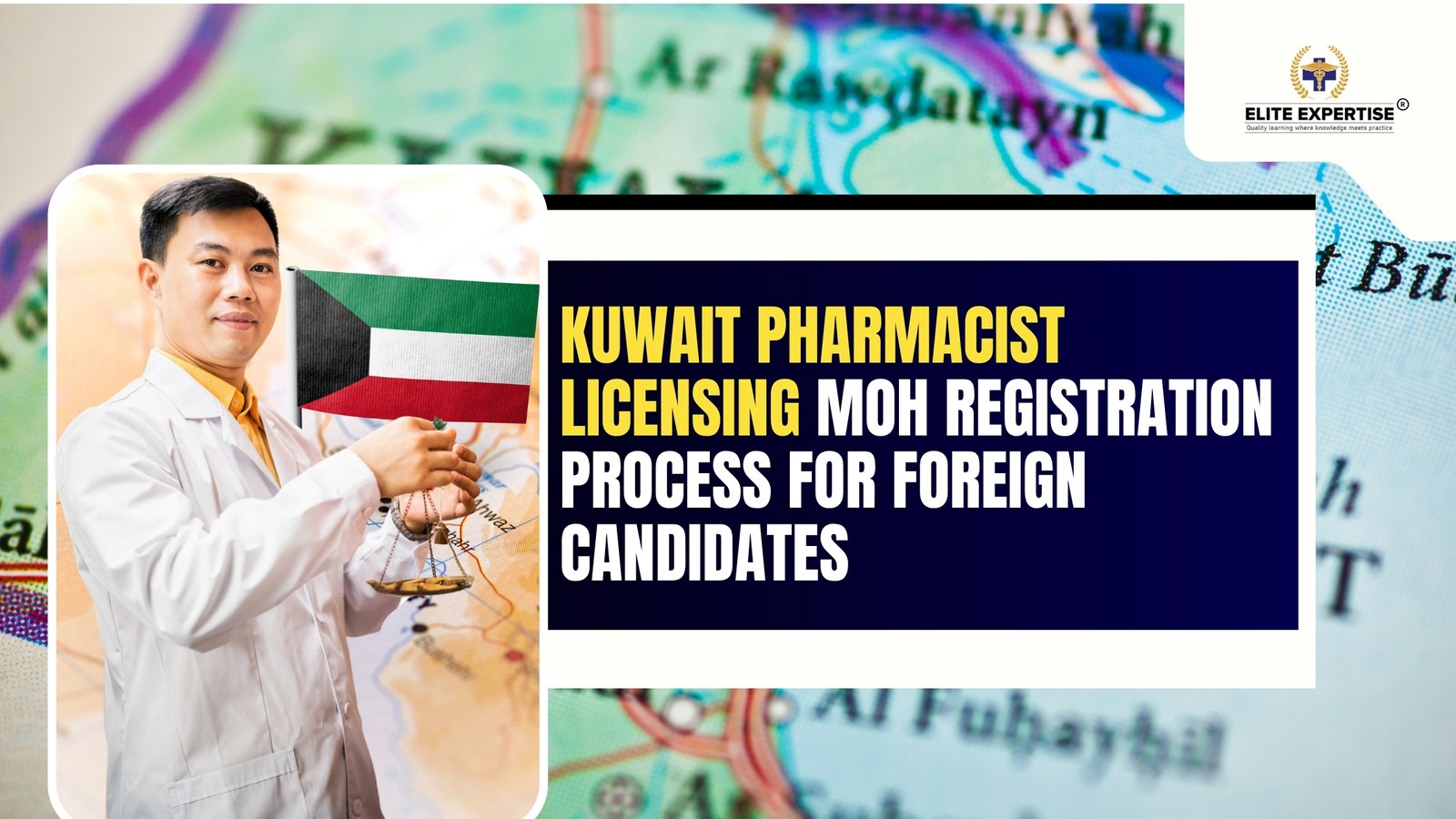
If you have been making plans to take forward a next big career move in the Gulf, Kuwait must stand as your top choice, given the valuable future there for pharmacists. The MOH (Ministry of Health), recognized as the official authority, is responsible for granting valid pharmacist licenses in the country.
To better understand how to become a pharmacist in Kuwait, you must first get to every other step involved regarding MOH, starting from document verification, examination to license approval. Without attaining this particular license, you cannot legally practice as a foreign pharmacist under any healthcare setting, whether it’s public or private.
Kuwait’s tax-free salary option, strong healthcare infrastructure, and ever growing demand for skilled pharmacists are some of the key factors making it the most rewarding destination for overseas pharmacists.
Keep reading as we explore more about MOH registration, examination, and the license process along with the importance of applying through professional help.
Qualification and Documentation Process
Before starting with the application process, you must ensure that you can meet with the respective license requirements for foreign pharmacists as set and allotted by the MOH. As a candidate, you must hold either B.Pharm (Bachelor of Pharmacy) or Pharm.D (Doctor of Pharmacy) from a renowned university and possess a valid pharmacy license to practice in your home country.
You’ll also need:
- Minimum two years of post-licensure work experience
- A Good Standing Certificate from your home pharmacy council
- Passport copy, CV, and your recent photographs
- Educational certificates and transcripts, attested by the Ministry of External Affairs and the Kuwaiti Embassy in your home country
Arabic proficiency is not mandatory but helps in communication with patients
DataFlow Verification & MOH Exam Details
The DataFlow verification is a critical part of Kuwait’s licensing system. It authenticates all your educational and professional credentials to prevent fraud. Only after successful DataFlow clearance can you appear for the MOH pharmacist exam.
The pharmacist exam Kuwait is a conducted as a computer-based test that certainly covers key areas like the:
- Pharmacology and Pharmaceutics
- Pharmacy Law and Pharmacotherapy
- Clinical Pharmacy and Pharmaceutical Calculations
The exam is has questions in English language and it may also include an oral component for certain applicants. By completing the mandatory training period at a government hospital before the actual test date is also required.
Tip: Study from the latest MOH exam MCQs and review guides to boost your chances of success
Application for License
Once you have cleared up the exam and the verification process, then follow the next step, which is to submit your application to the Licensing Department of the Kuwait MOH.
Applications can either be submitted directly by the candidate or through a sponsoring employer (like a pharmacy chain or a hospital). Once your credentials and the exam results are evaluated and approved, you will receive your unique MOH Pharmacist Identity Card, which further lets you work legally across Kuwait.
Many foreign candidates have completed the entire process in a time frame of about three to six months, and it does vary based on the document verification and the scheduling timelines.
Career Scope and Valuable Job Opportunities
Once you have attained the license, as a pharmacist you get to explore a wide range of opportunities all over Kuwait’s healthcare sector.
Top Career Options Include:
- Government Hospitals: Directly managed by MOH, offering valid job stability and work-related benefits.
- Private Hospitals & Clinics: Fast-growing option with higher and better salaries.
- Community Pharmacies: Ideal choice for those who are looking forward to taking on direct patient care.
- Pharmaceutical Companies: Roles in research, regulation, or sales.
- Academic Institutions: Teaching roles for experienced professionals.
Pharmacists servicing in Kuwait do earn anywhere between KWD 800 to 1500 per month, and specialized roles and senior professionals are offered with KWD 3,000 and more. As Kuwait offers 100% tax-free income, all your earnings do remain yours, making it the most financially attractive destination to serve a healthcare professional.
Conclusion
By now you must have better understand how to become a pharmacist in Kuwait with our detailed process listed in simple words as above. All you need to do is to follow the process, from qualification verification, DataFlow checks, exam clearance, and then final MOH registration.
By rightly and timely completing the documentation, exam preparation, and remaining persistence, as a foreign pharmacist, you are about to build a valuable career in Kuwait under the growing healthcare industry.
Having professional help available by your side during the application and exam preparation process will let you save your time and money. Harika Bheemavarapu and Arief Mohammed, the experts at Elite Expertise have helped thousands of pharmacists attain their practice license abroad, through their continuous guidance and support. Reach them out now to kick start your pharmacist career in Kuwait.
Frequently Asked Questions (FAQs) About Kuwait Pharmacist Licensing (MOH)
1. Who regulates pharmacist licensing in Kuwait?
The Ministry of Health (MOH), Kuwait, is the sole authority responsible for evaluating, verifying, and approving pharmacist licenses for both local and foreign candidates.
2. What are the basic qualifications required to apply for the Kuwait MOH pharmacist license?
You must hold a B.Pharm or Pharm.D degree from an accredited university, possess a valid home country license, and have at least two years of post-licensure experience to apply.
3. What is the DataFlow verification process for Kuwait MOH licensing?
DataFlow verification is an official process to authenticate educational, professional, and personal documents. Only after successful DataFlow clearance can you appear for the MOH pharmacist exam.
4. What subjects are covered in the Kuwait MOH pharmacist exam?
The exam primarily covers Pharmacology, Pharmaceutics, Clinical Pharmacy, Pharmaceutical Calculations, and Pharmacy Law — all in English.
5. How can I apply for the MOH pharmacist exam in Kuwait?
You can apply online through the Kuwait MOH Licensing Department portal or via a sponsoring employer such as a hospital or pharmacy group.
6. How long does it take to complete the entire licensing process?
The full process — including document attestation, DataFlow verification, exam, and final approval — usually takes around 3 to 6 months, depending on document accuracy and exam availability.
7. Is Arabic language proficiency mandatory for foreign pharmacists in Kuwait?
No, Arabic is not mandatory, but having basic communication skills can be an advantage when interacting with patients and healthcare staff.
8. What is the average salary for licensed pharmacists in Kuwait?
Licensed pharmacists in Kuwait typically earn between KWD 800 to 1,500 per month, with senior roles exceeding KWD 3,000, all tax-free.
9. Can I work in Kuwait without an MOH pharmacist license?
No. Practicing pharmacy in Kuwait without a valid MOH-issued pharmacist license is strictly prohibited and considered illegal.
10. What are the top employment opportunities after getting the Kuwait MOH license?
Licensed pharmacists can work in government hospitals, private clinics, community pharmacies, pharmaceutical companies, or even academic institutions across Kuwait.